AI-generated illustration — not a retailer product photo.
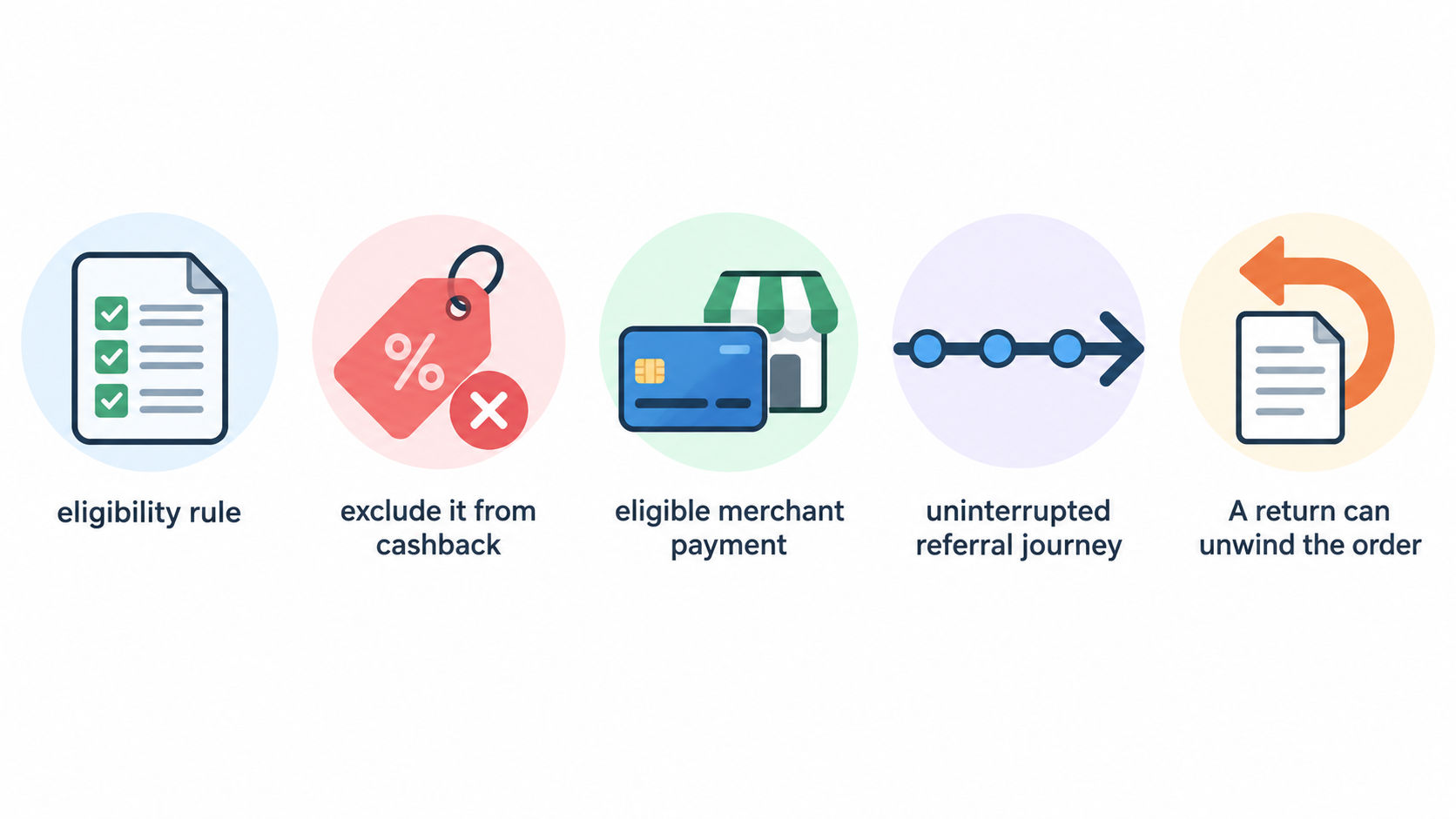
Online savings can look deceptively simple: click through a cashback site, paste a voucher code, pay with a card offer and expect every benefit to arrive. In practice, those three systems may each use a different eligibility rule. A retailer may accept the code but exclude it from cashback. A card offer may require an eligible merchant payment, while a cashback portal may need an uninterrupted referral journey. A return can unwind the order and the rewards attached to it.
The safe approach is not to collect every possible badge at checkout. It is to decide which saving is evidenced, which is conditional, and which should be abandoned. This guide gives a repeatable UK checkout sequence for normal online shopping. It does not promise that a particular retailer, portal or card offer will stack; the page-specific terms at the moment of purchase always win.
Affiliate disclosure: UK Discounts and Deals may earn a commission when readers use some links. Our editorial guidance is written to help you judge the full cost, terms and return implications, not to encourage unnecessary spending. Read about us and our editorial policy for how we work.
The safe stacking order: value first, rewards second
AI-generated illustration — not a retailer product photo.
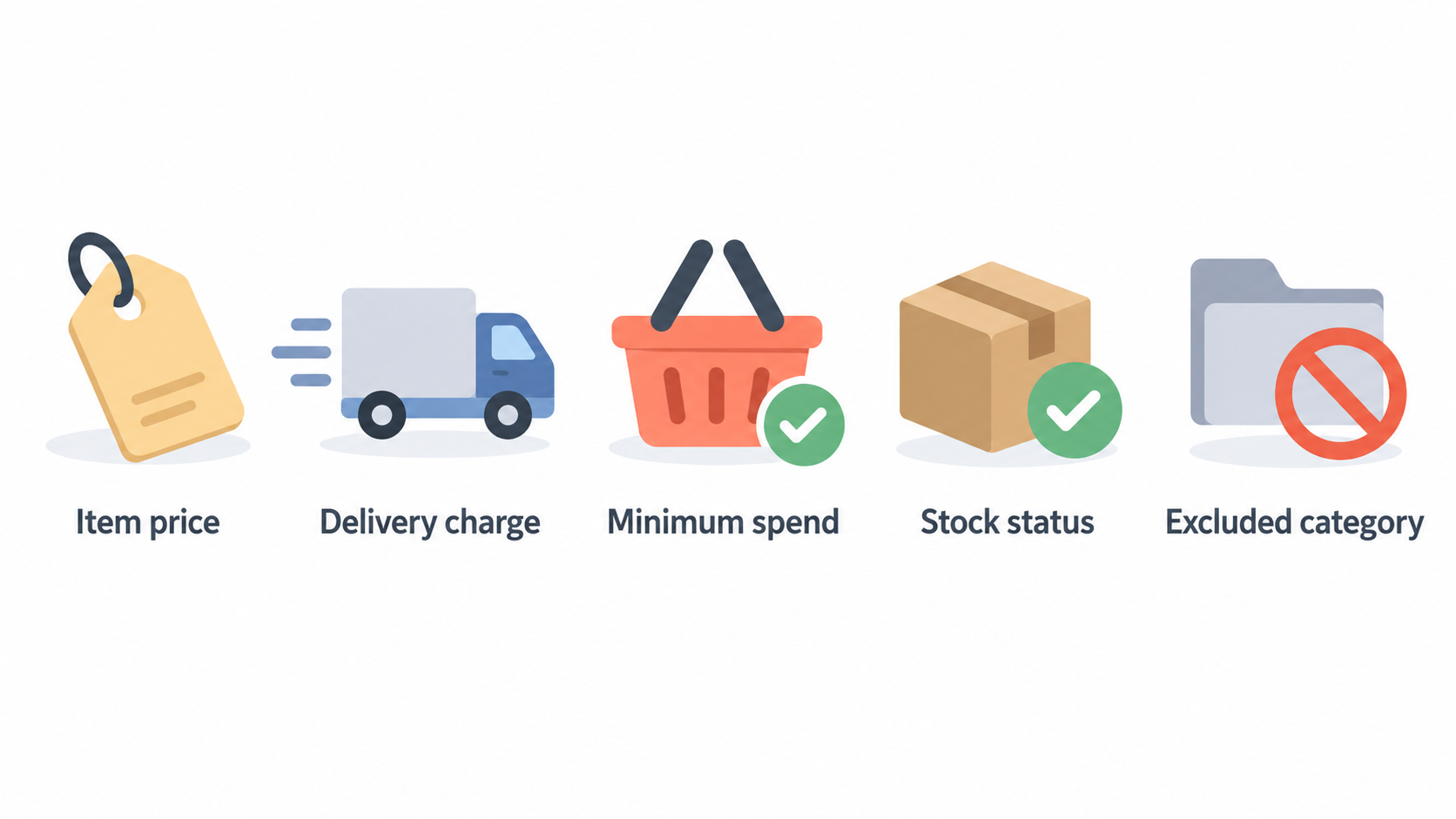
Start with the item, not the reward. Check that the retailer’s delivered price, delivery timing and returns position make sense even if the cashback later tracks at £0. A conditional reward is not a price reduction at the moment you pay.
Then work through this order:
- Price and basket: record the item price, delivery charge, minimum spend, stock status and any excluded category.
- Retailer promotion: read the retailer’s own code or sale terms. Check whether the code is account-specific, new-customer-only, one use per household, excluded from sale items, or tied to a particular delivery option.
- Card offer: save or activate the offer before the transaction. Confirm the eligible merchant, dates, qualifying amount, payment route and whether the stated spend is one purchase or cumulative.
- Cashback route: open the portal’s retailer page and read the exclusions before clicking through. Use one portal only.
- Clean checkout: complete the order in the same browser and session. Do not browse through competing portals, extensions or marketplace links after activating cashback.
- Evidence: save the offer terms, cashback rate and order confirmation. Take a screenshot only as a record; it does not override terms.
- Post-purchase check: confirm the order total, expected delivery date and return window. Treat pending cashback and a pending statement credit as provisional.
This sequence is deliberately conservative. It prevents a common mistake: entering a code first, then trying to rebuild the tracking path afterwards. If the savings depend on a particular route, establish that route before the retailer checkout changes your browser session.
Build an evidence card before you click “pay”
AI-generated illustration — not a retailer product photo.
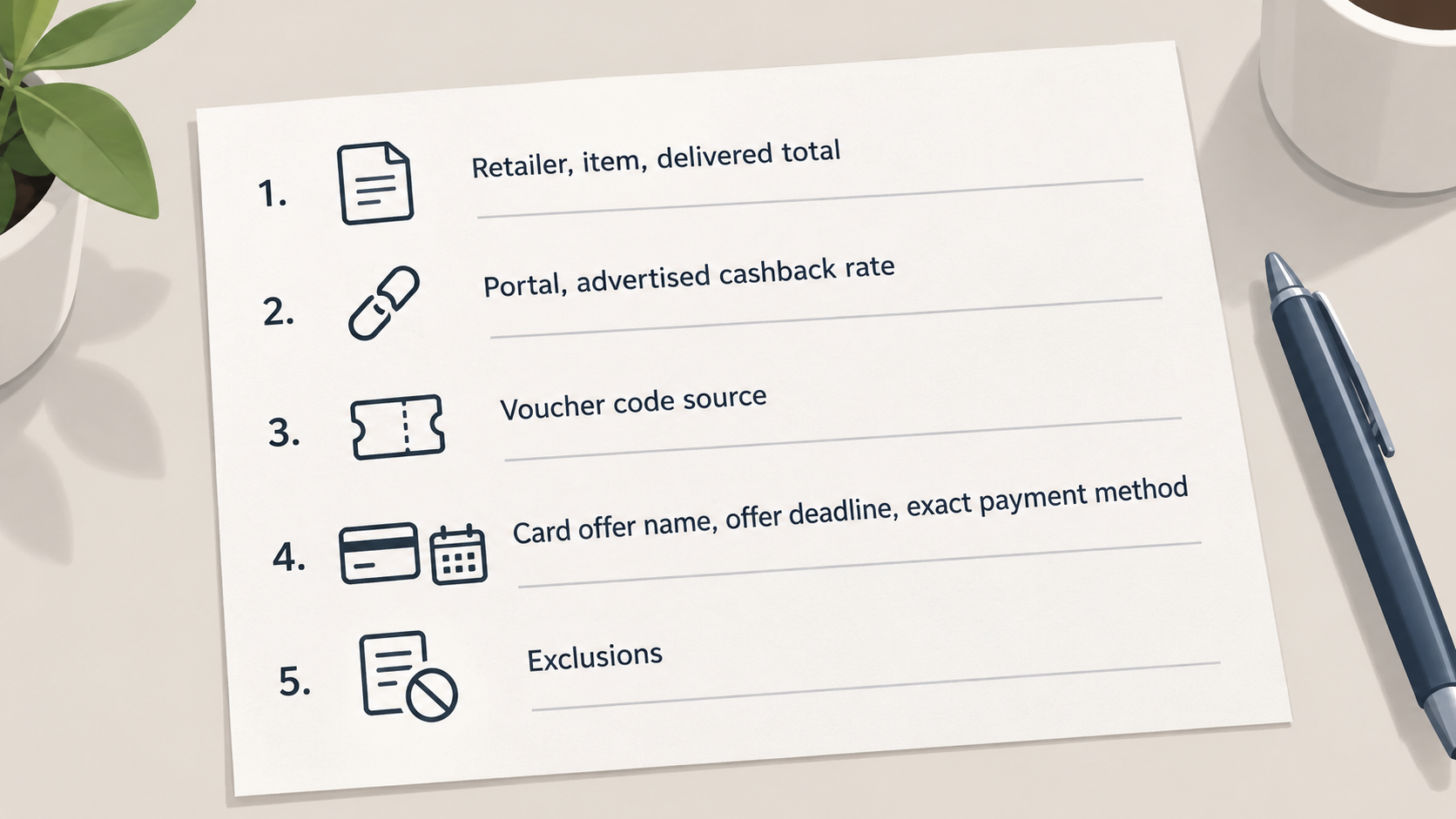
For a purchase worth more than a few pounds, make a short evidence card. It takes less time than chasing a missing cashback claim or returning an item bought only to meet a threshold.
Write down the retailer, item, delivered total, portal, advertised cashback rate, voucher code source, card offer name, offer deadline and the exact payment method. Add one line for exclusions. “Code from Google” or “should stack” is not an exclusion check.
A useful question is: what must be true for each reward to survive? For cashback, it may be a tracked click, eligible category, no unauthorised code and no return. For a card offer, it may be prior enrolment, a matching merchant descriptor, a minimum qualifying spend and payment on the enrolled card. For a voucher, it may be a minimum basket value or a particular product range.
This is also where you check whether a cheaper route exists without any stack. For example, a code may reduce the order by more than the cashback rate would return, or a retailer’s own sale price may already be lower than the price through a partner landing page. Our guide to deciding whether a UK voucher is actually worth using is a useful second check before you commit.
Cashback tracking: one referral path, one realistic expectation
AI-generated illustration — not a retailer product photo.
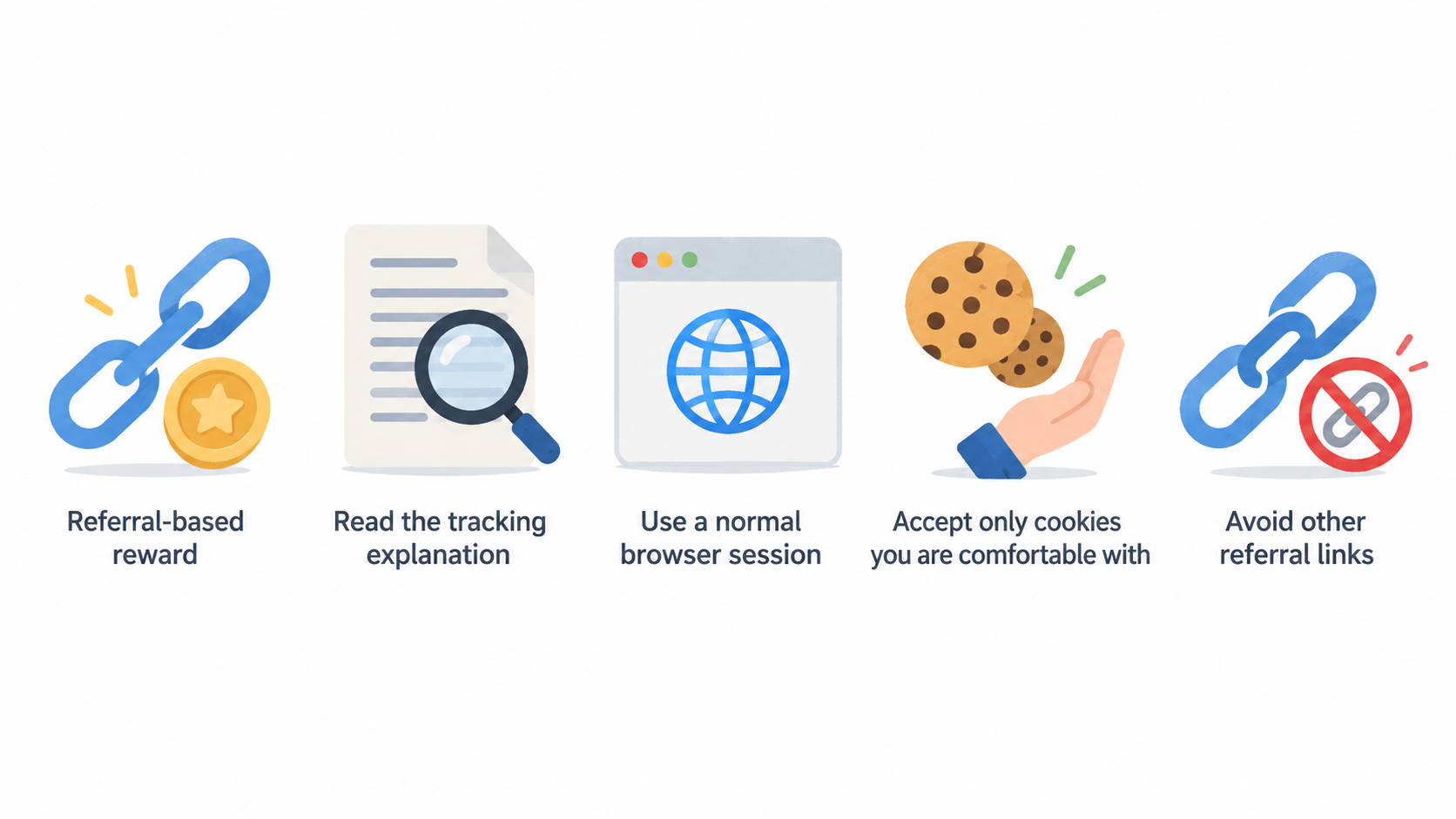
Cashback is normally a referral-based reward, not an instant discount. TopCashback explains that an affiliate-network cookie can carry the click-through information to the retailer; blocking or deleting the relevant cookies may affect whether cashback can be claimed. Read its cookie and tracking explanation before assuming privacy tools, a browser extension or a device switch are harmless to the purchase path.
Use a normal browser session, accept only the cookies you are comfortable with, and avoid opening a second cashback service. Do not click an ad, price-comparison result, influencer link or another portal after the cashback click. Any of those actions can replace, interrupt or make the referral evidence unclear.
Keep the basket simple. If the retailer page says a code, gift card, subscription, finance product, marketplace seller, click-and-collect order or excluded category is not eligible, assume cashback is at risk. Do not rely on a portal-wide rule when the retailer page gives a more specific one.
The practical expectation is “tracked, then reviewed, then payable,” not “cashback now.” Quidco says a purchase is often tracked within hours, though some retailers can take up to seven days; retailer review can take from days to months. Only confirmed cashback can be withdrawn. Its cashback and withdrawal guidance also makes clear that bank, PayPal and gift-card withdrawal are separate choices after confirmation.
For a broader comparison of routes and payout trade-offs, see Best UK Cashback Options for Online Shopping. The important point here is that payout reliability starts with following the individual retailer page, not with choosing the highest headline percentage.
Voucher codes: retailer-verified beats internet-found
A voucher code can be the strongest saving in the basket because it changes the payable total immediately. It can also be the easiest way to lose cashback. Treat a code as compatible only when one of these is true:
- the cashback portal lists that exact code for that retailer;
- the retailer applies the reduction automatically and the portal’s retailer page says sale or automatic promotions remain eligible; or
- the retailer and cashback-page terms expressly say the combination is allowed.
Quidco states that its listed voucher codes can sit alongside cashback for the relevant retailer, but a code found elsewhere may cause cashback not to track or be declined. That is why a search-engine snippet, a browser extension’s suggestion or an old forum code is not enough evidence. The code might still reduce the price, but you should calculate the basket as though cashback could disappear.
Before entering a code, check the minimum spend after excluded items, delivery charge, gift-card treatment and whether the code is one per customer. A £10 discount that requires you to add £15 of unwanted goods is not a £10 saving. Likewise, a free-delivery code may be more valuable than a small cashback percentage on a low-value basket.
If the code works but the cashback terms are unclear, choose the verified saving rather than claiming both in your budget. You can still place the order; just do not describe unconfirmed cashback as money already earned.
Card offers: activate first, pay the eligible merchant directly
Card offers are separate from retailer and cashback terms. They usually depend on transaction data reaching the card issuer in the expected form. That makes the eligible merchant, payment route, date and enrolled card more important than the marketing headline.
American Express says that an Amex Offer must be saved to an eligible card before purchase, and the qualifying transaction must be made with that same card. It also says that offer terms determine whether a minimum applies to one purchase or multiple purchases, and whether online, in-store or particular locations qualify. Check the current Amex Offers terms and FAQs in your account because individual merchant terms can be narrower than the programme summary.
Read the small print for:
- Activation: has the offer been saved to the exact card you will use?
- Merchant identity: does the offer name the retailer, a group company, a participating branch or a website?
- Payment route: is a marketplace, digital wallet, payment facilitator, PayPal, finance option or third-party checkout excluded?
- Spend test: is the threshold based on the goods total, delivered total, one transaction or cumulative transactions?
- Timing: must the merchant charge the card, dispatch the goods or complete the service before the deadline?
- Reversals: does a cancellation, partial refund or return remove the credit?
Do not force a card offer into a checkout where it breaks the evidence for the better saving. If a cashback portal warns that a payment route may not track, or the card offer excludes that route, choose the route with the clearest documented value. A statement credit received later is useful, but it is not a reason to ignore a retailer’s delivery or return costs today.
Returns, cancellations and the true cost of a “saving”
A stack is only successful if the purchase remains eligible after the retailer’s return period. A returned or cancelled order can remove cashback, reverse a statement credit, invalidate a threshold calculation or send a refund back to the original payment method.
American Express notes that it may reverse rewards or statement credits after a return or cancellation. Retailer terms matter too. Argos, for example, says delivery charges and estimated timings are shown during checkout, offers a 30-day money-back guarantee subject to exclusions, and may apply a collection charge for some returned large home-delivered items. Read the retailer’s current terms and returns position rather than assuming every online order has the same cost to unwind.
Do not buy multiple sizes, colours or alternatives simply to cross a cashback or card-offer threshold unless you would be comfortable with the return process and any non-refundable delivery or collection charge. The “saving” can vanish if the retained item falls below a minimum spend after the refund.
For a retailer-specific total-cost example, compare Amazon UK and Argos delivery, returns and deal value. The same principle applies elsewhere: the best checkout is the one that remains good after delivery, a possible return and the loss of conditional rewards.
A stop rule for offers you cannot verify
Use this stop rule: do not stack an offer when you cannot point to a current retailer, cashback-provider or card-offer term that supports the exact path you plan to take.
Stop and simplify when:
- the voucher came from an unverified source and the cashback page does not list it;
- a browser extension claims a code but does not show compatibility terms;
- the card offer does not clearly identify the merchant or payment route;
- the checkout redirects to a marketplace, finance provider or payment intermediary;
- the product may be returned and the cost of return would erase the likely benefit;
- you would need to add unwanted items to meet a threshold;
- the claimed saving is less than the uncertainty or extra spend required.
Simplifying can mean using only the retailer code, only the card offer, or only cashback. It can also mean walking away. That is not leaving money on the table; it is avoiding a purchase whose economics depend on terms you cannot verify.
A quick way to compare the stack with the plain purchase
Calculate the certain saving first:
| Component | Count it now? | What to verify |
|---|---|---|
| Retailer price reduction | Usually yes | Code applied, minimum spend, excluded products |
| Delivery saving | Usually yes | Delivery method, threshold and postcode restrictions |
| Cashback | No, until confirmed | Portal click, retailer exclusions, return period |
| Card statement credit | No, until credited | Saved offer, enrolled card, merchant and payment route |
| Return cost | Yes, if plausible | Return window, collection fee and refund method |
If the plain delivered price is £100 and a verified retailer code reduces it to £90, budget from £90. If a portal advertises 5% cashback and a card offer may produce £10 back later, describe the potential result as “up to £20 conditional after confirmation,” not as a £70 purchase. This protects you from spending against money that may never become payable.
If delivery and returns are the main issue rather than the code, our Argos deals review explains why total value is more than the headline promotion.
FAQs
Can I use a cashback site and a voucher code together?
Sometimes, but only when the cashback provider’s retailer page allows that code or says retailer-applied promotions remain eligible. A code can reduce the basket successfully while still breaking cashback eligibility. Treat cashback as uncertain unless the code is explicitly permitted.
Should I activate a card offer before or after clicking through cashback?
Activate the card offer first, then read the cashback retailer terms and begin one clean click-through journey. Activation normally does not require a competing referral click. If the card offer requires a particular link or payment route, do not assume the cashback route remains compatible.
What if my cashback is pending but my card credit has arrived?
They are independent rewards. Keep the order confirmation and follow the cashback provider’s claim process only after its stated tracking or pending period. Do not make a second purchase merely because the first reward is delayed.
Does using PayPal or a digital wallet stop a card offer or cashback?
It can. Cashback and card-offer exclusions often depend on how the merchant and payment intermediary report the transaction. Check the individual retailer and card offer terms. If the wording is unclear, pay through the eligible direct route or do not count the reward.
What happens to cashback and a card offer if I return part of an order?
A partial return can reduce eligible spend below a minimum, change the cashback calculation or cause a credit reversal. Check the retailer’s refund method and the reward terms before returning. Budget as if conditional rewards may be recalculated.
Is it worth spending more to hit a cashback or card-offer threshold?
Only if the extra item is needed at its normal delivered price. Compare the additional spend with the maximum conditional reward and the possibility of a return. A threshold is a condition, not a reason to increase your basket.
Verification note
Terms and help guidance in this article were checked on 12 July 2026 against official TopCashback, Quidco, American Express and Argos pages. Cashback rates, merchant lists, voucher compatibility, card offers, delivery charges and return exclusions change frequently. Recheck the exact retailer, portal and card terms immediately before payment.
A safe stack is intentionally boring: buy what you wanted, pay a price that already makes sense, and regard every later reward as a bonus until its terms have been met and it has been confirmed.
Editorial information: Read our affiliate disclosure.