
How to Compare the Real Checkout Cost of an Online Deal
A product page says “20% off”, a voucher box accepts your code, and the basket looks cheaper than it did five minutes ago. That is the moment many shoppers stop comparing. It is also the point at which the important costs begin to appear: delivery, a paid membership, a higher finance total, a return fee, a voucher exclusion, or cashback that may never become payable.
The useful number is not the percentage printed beside the product. It is the amount you are realistically committed to pay for the item, delivered in the way you need, with a return route you can live with. If two retailers sell the same item, the lower headline price is not automatically the lower checkout cost.
This guide gives UK shoppers a practical decision process for comparing an online deal. It covers delivery and collection, membership prices, financing, returns, cashback, voucher terms, price history and retailer reliability. It is not a live-deals list or a promise that every offer will work. Policy links and price-context sources below were checked on 13 July 2026; retailer terms, stock and promotion conditions can change before you pay. Read our editorial policy and about page to see how we separate practical shopping guidance from commercial incentives.
Build a final-cost comparison before you chase the discount
AI-generated illustration — not a retailer product photo.
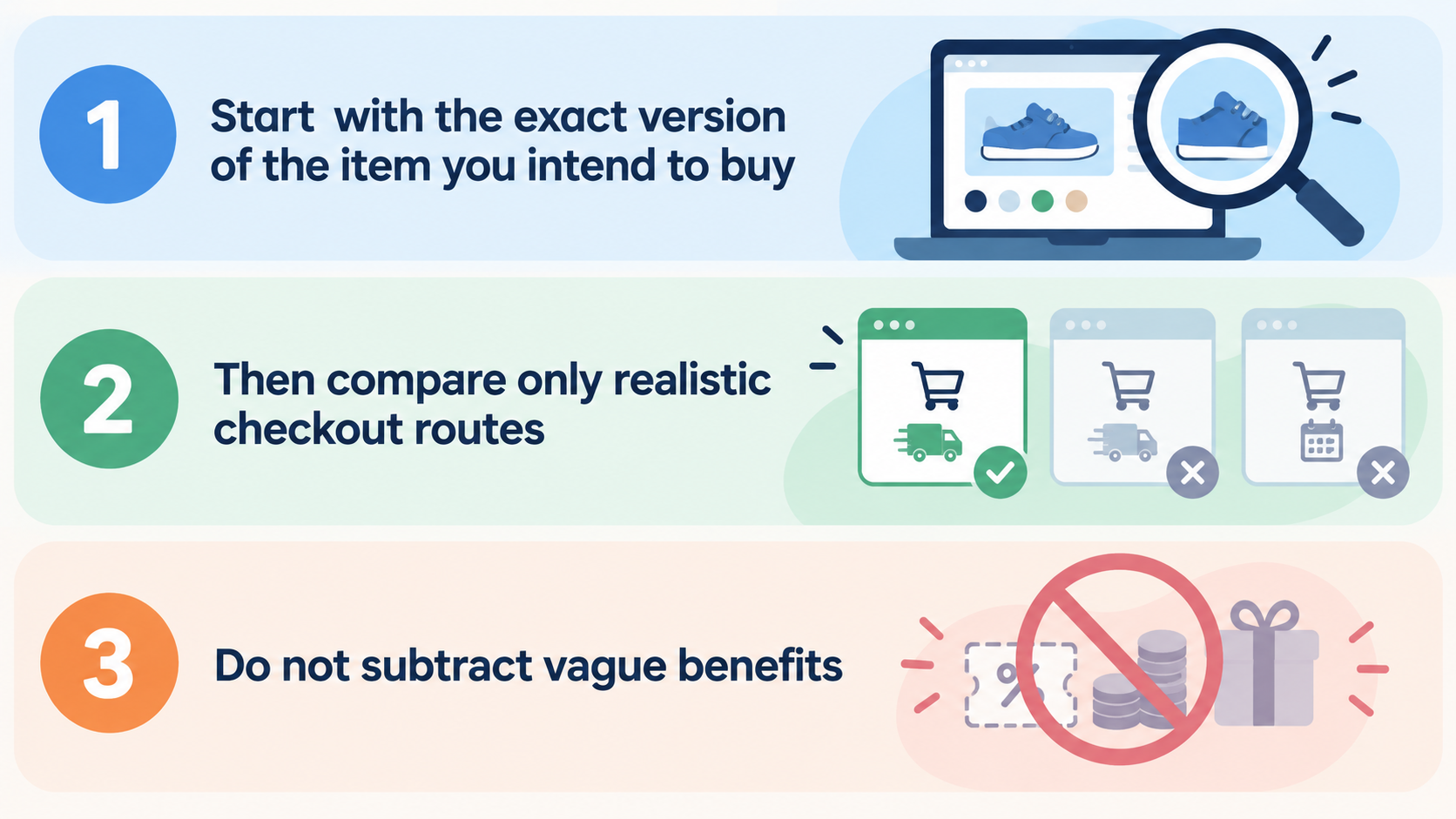
Start with the exact version of the item you intend to buy: model number, size, colour, capacity, seller, warranty and delivery date. Then compare only realistic checkout routes. A £10 code does not matter if it applies to a different colour, a marketplace seller with a weaker return route, or a delivery date that does not work for you.
Use this simple calculation for each retailer:
| Cost or value | Include it when |
|---|---|
| Item price after an eligible discount | The code, sale or member price actually applies to your chosen item |
| Delivery or collection | You cannot use a free, practical fulfilment route |
| Membership fee or trial renewal | Membership is required for the price or delivery benefit |
| Finance cost | You will use credit rather than pay in full |
| Likely return cost | Size, compatibility, installation or condition creates a genuine return risk |
| Confirmed cashback | It is tracked, validated and payable, not merely advertised |
| Other real value | Included installation, recycling, warranty or collection solves a cost you would otherwise pay |
Do not subtract vague benefits. “Free next-day delivery” has no value if standard delivery would arrive in time. A bundle is not a saving if one part will sit unused. Loyalty points matter only if you normally use them and understand their expiry or redemption rules.
A practical comparison also separates certain cost from possible cost. The item price and delivery fee are certain at checkout. A £30 large-item collection charge is a possible cost if you are unsure about fit or suitability. Cashback is a possible benefit until it has passed the provider’s tracking and confirmation stages. Treating all three as equal is how a small advertised saving becomes an expensive purchase.
Compare delivery and collection as part of the product price
AI-generated illustration — not a retailer product photo.
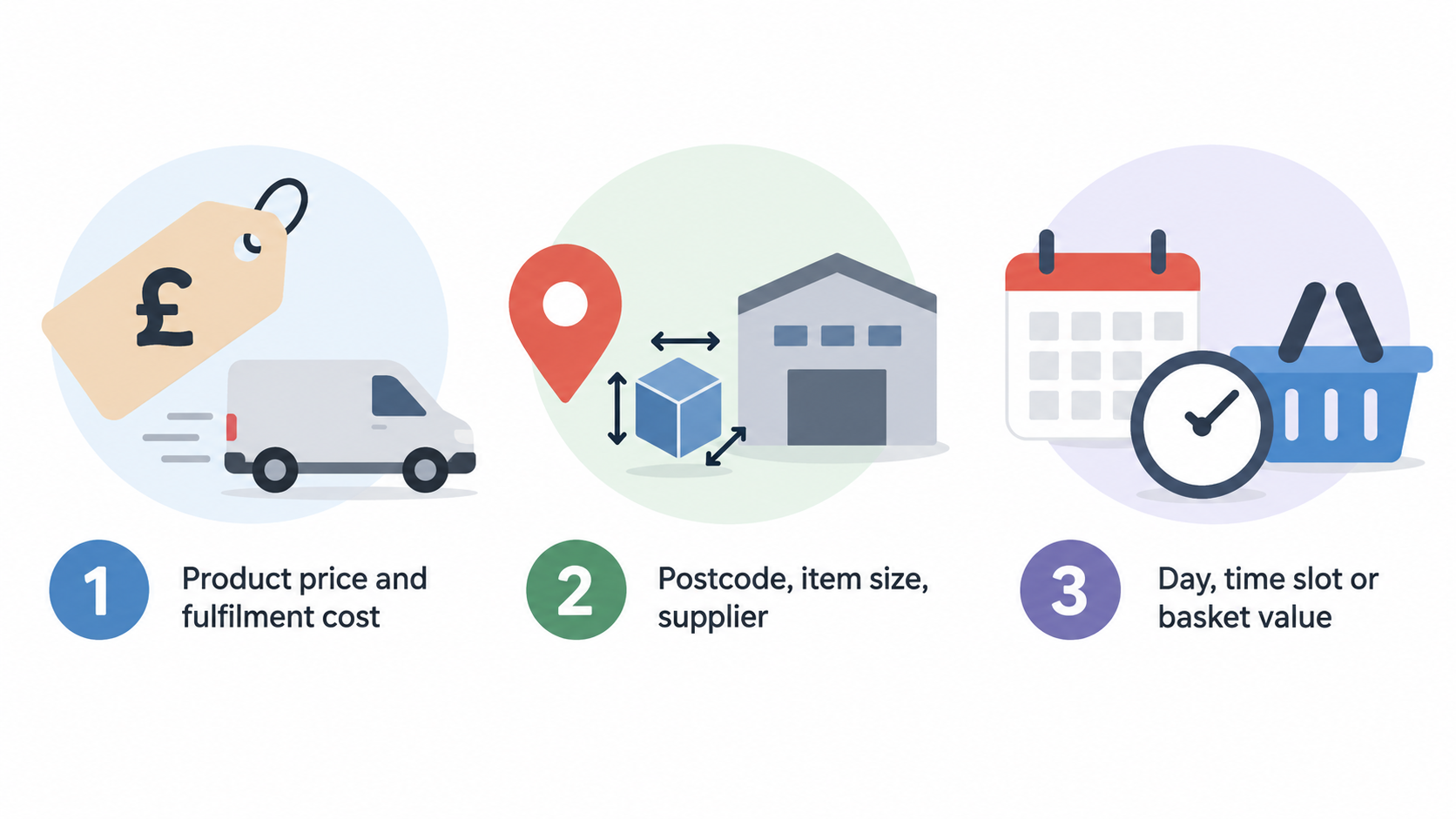
Delivery is not an afterthought. It is part of the offer. Before comparing retailers, put the product price and fulfilment cost in the same line. Check whether delivery changes by postcode, item size, supplier, day, time slot or basket value. A retailer can look cheaper on the listing page yet lose once its delivery option is shown.
Collection can be the stronger route when it removes a delivery charge and is genuinely convenient. It is weaker when petrol, parking, a long journey or an inflexible collection window turns a £4.95 delivery saving into wasted time and expense. For a small urgent item, local collection may be valuable even if it costs a little more. For a bulky item, a booked home-delivery slot may be worth paying for if it avoids a second trip.
Use a like-for-like table rather than comparing one retailer’s cheapest possible option with another retailer’s fastest paid option:
| Retailer route | Ask before treating it as the cheaper deal |
|---|---|
| Standard delivery | What is the final charge and delivery date? |
| Click and collect | Is the collection point practical and is the item actually reservable? |
| Paid express delivery | Would standard delivery meet the same need? |
| Supplier or large-item delivery | Are room delivery, recycling, installation or missed-delivery costs included? |
| Free-delivery membership | Is the membership needed for more than this purchase? |
Argos is a useful example of why return logistics belong in the comparison. Its current help page says items can normally be returned within 30 days of delivery or collection, but large delivered items cannot be returned in store and a non-faulty collection can cost £30. It also says delivery fees are refunded only when the whole order is returned. Read the Argos return policy for the current route and exclusions rather than assuming every product follows the same path.
Price membership offers as a separate purchase
AI-generated illustration — not a retailer product photo.
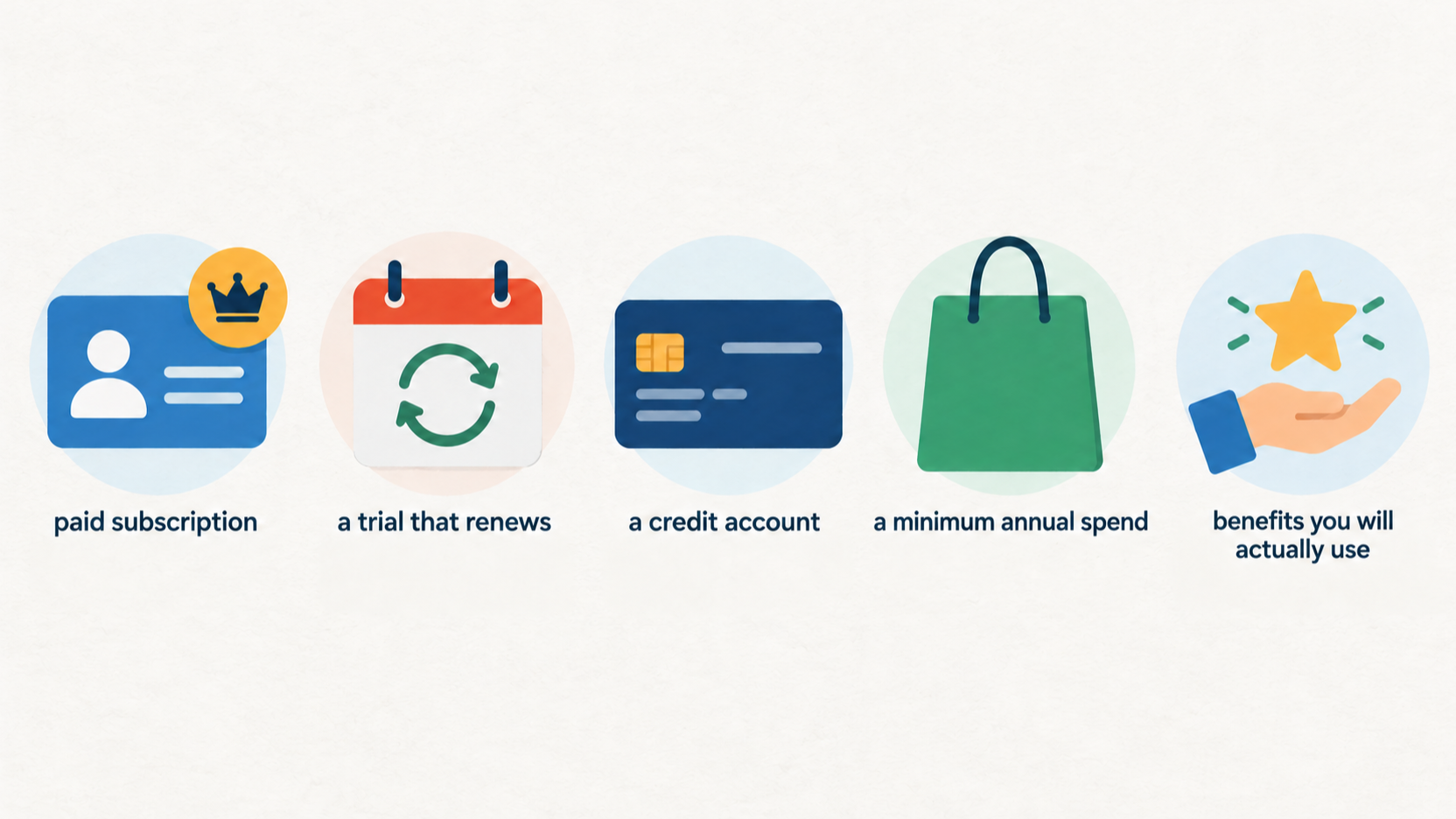
A member price can be useful, but it is not automatically free. Ask whether the discount needs a paid subscription, a trial that renews, a credit account, a minimum annual spend or a loyalty scheme you would not otherwise join.
For a free loyalty account, the real cost may be your time, promotional emails and the chance that a member-only price becomes the reference point that makes a normal price look high. For a paid membership, calculate the fee against the benefits you will actually use. If the membership costs £10 and saves £8 on this order, the checkout is not £8 cheaper unless you have a definite use for at least £2 of future value.
Do not assign full value to a trial unless you have checked its renewal date and cancellation route. Set a calendar reminder immediately if you only need the first delivery benefit. Do not buy extra items merely to “make the membership worth it”; that reverses the calculation.
Membership prices are strongest when you already use the retailer often, the fee is already paid, and the offer beats non-member alternatives after delivery. They are weakest when the stated saving is based on an inflated non-member price or when one purchase is being used to justify a recurring cost.
Read voucher exclusions before changing your basket
A voucher is a rule set, not money. Before adding filler items or switching products, read the minimum spend, expiry, excluded categories, seller limitations and whether the code can combine with a sale, student discount, loyalty reward or cashback click-through.
The first comparison should be between your planned basket and the voucher basket. If you planned to spend £44 but add £12 of unrelated products to clear a £50 threshold for £5 off, your spend has risen. The code may still be useful if every added product was already needed, but it is not a £5 saving on the purchase you originally intended to make.
Check these details at the same time:
- Does the minimum spend apply before or after delivery, returns deductions or gift-card use?
- Is the code valid for your exact model, size, colour, brand and seller?
- Does it exclude clearance, bundles, marketplace goods, finance purchases or subscriptions?
- Will a partial return remove the discount or reduce the refund?
- Is the code single-use, account-specific or limited to a first order?
For a fuller code-by-code decision process, use How to Decide Whether a UK Voucher Is Actually Worth Using. The important distinction here is wider: even a valid voucher does not prove that this retailer has the lowest final cost.
Count cashback only after it becomes payable
Cashback is not a discount from the amount charged to your card. It is a later reward that can fail to track, be declined because of a term, or take time to confirm. That does not make cashback unhelpful. It means it should be placed in a separate column from guaranteed checkout savings.
Before clicking through a cashback provider, check the retailer’s displayed rate, excluded product categories, new-customer rules, voucher-code restrictions and any requirement to complete the purchase in one browser session. Avoid opening comparison tabs after the tracked click if the provider warns that another referral can replace it. Keep the order confirmation until the cashback status is resolved.
Use three labels:
- Checkout saving — already reflected in the amount you pay today.
- Tracked cashback — recorded but not yet certain.
- Payable cashback — validated and available under the provider’s withdrawal rules.
Only the third is cash-equivalent. If a retailer is £8 cheaper today but another promises £10 pending cashback, the first retailer may still be the lower-risk choice. Review the provider’s current TopCashback terms before relying on an offer, and see our UK cashback options guide and safe stacking guide for the tracking and combination boundaries.
Treat finance as a payment choice, not a discount
“£0 today”, “pay in three” and monthly-payment figures can make an item feel affordable without reducing its total cost. Compare the full cash price, deposit, number of payments, interest or fees, late-payment consequences and whether a voucher or cashback offer still applies when finance is selected.
A genuine 0% offer can help with cash flow if the repayment dates fit your budget and the item is fairly priced. It does not turn a higher-priced retailer into the cheaper retailer. A finance option with interest should be compared using the total amount payable, not the monthly figure. Do not add optional warranties, delivery upgrades or accessories into a finance basket simply because the monthly difference looks small.
If the promotion says “credit subject to status”, it is not a guaranteed route. It can also involve an application or a different set of terms. The UK Financial Conduct Authority’s buy now, pay later information is a useful starting point for understanding the product category, but it is not a substitute for the retailer’s own finance agreement.
A good stop rule is simple: if you cannot explain the total amount payable, the repayment schedule and what happens if you return part of the order, do not let finance decide the purchase.
Put return risk beside the saving
Returns are where the theoretical saving becomes personal. A low-priced coat, chair, mattress, laptop accessory or appliance can be expensive if you are likely to return it and the retailer’s route is inconvenient or chargeable.
Check the exact product page, not only a headline policy. Some categories have hygiene, activation, personalised-product, assembly or supplier exceptions. Some retailers offer a long goodwill window but still deduct postage or collection. A full-order return can be treated differently from a partial return where a voucher, delivery threshold or bundle price changes.
UK distance-selling rules provide a baseline for many online orders, but they do not remove the need to understand the retailer process. The GOV.UK guidance on online and distance selling explains that consumers need cancellation information and that businesses must disclose delivery costs before an order is placed. Your realistic cost still depends on the item, the reason for return and the route offered.
For uncertain purchases, add an honest expected return cost to the comparison. If you think there is a one-in-three chance of returning a large item and collection would cost £30, that risk is more meaningful than a £5 code. You do not need to predict the future perfectly; you only need to stop pretending a difficult return has no cost.
Use price history to test the “was” price
A discount can be real without being especially good. Compare the exact model across retailers, including delivery, warranty, included accessories and availability. Then ask what the item has usually sold for.
Which? advises shoppers to compare total prices, including delivery, and notes that “was” prices can give a misleading impression when an item has recently sold at several lower prices. Its guide points to CamelCamelCamel for Amazon history and PriceRunner for wider comparisons; see How to get the best price when shopping online.
Price history is context, not a command to wait forever. A low historic price may have occurred during limited stock, a previous model cycle or a short promotion that will not return. Use it to judge whether today’s claimed reduction is normal, unusual or merely decorative. If the item is urgent, reliable delivery and a simple return may be worth more than waiting for a possible £5 drop.
Check merchant reliability before you transfer the risk
The cheapest offer is not the cheapest outcome if the seller is hard to identify, impossible to contact or unclear about fulfilment and returns. This matters especially on marketplaces, comparison results, sponsored listings and unfamiliar websites.
Before paying, check:
- the trading name, UK contact details and returns address;
- whether the item is sold by the retailer itself or a third-party marketplace seller;
- the delivery estimate, return instructions and who pays for a return;
- independent reviews for recurring fulfilment or refund problems, not just a star average;
- payment protection and whether the checkout is secure and recognisable;
- whether the product description gives a model number, condition, warranty and what is included.
A smaller discount from a reliable retailer can be the better deal if it provides a clear delivery promise, recognised payment method and workable after-sales support. This is particularly true for expensive electronics, furniture, travel-related purchases and items where compatibility is uncertain. For retailer-specific delivery and return trade-offs, compare our Amazon UK vs Argos total-deal-value guide.
Make the decision with one final checklist
Before you press pay, write down the final amount for each realistic route. Include only benefits you can explain and costs you could actually incur. Then ask:
- Would I still buy this exact item without the headline discount?
- Is the final cash checkout lower after delivery or collection?
- Does a membership or finance choice add a cost I would otherwise avoid?
- Can I return it without a disproportionate fee or inconvenience?
- Is cashback confirmed, or merely a possible future reward?
- Does price history show a meaningful reduction?
- Would I be comfortable if this merchant had to resolve a problem after delivery?
The right deal is rarely the one with the largest percentage. It is the one that leaves you with the item you wanted, a checkout total you understand, and no hidden condition waiting after the payment screen.
FAQ
Should I compare cashback before or after delivery costs?
Compare delivery first because it is charged today and is usually certain. Cashback should sit in a separate column until it becomes payable. A £4.95 delivery charge can erase a £4 checkout saving immediately, while a larger cashback figure may still be declined or delayed under the provider’s terms.
Is click and collect always cheaper than home delivery?
No. It can remove a delivery fee, but it may add travel, parking or time costs. It is usually strongest when the collection point is already on your route and the retailer confirms stock. For bulky items, scheduled delivery can be better value if collection is impractical or creates a difficult return route.
Can a paid membership make one online deal cheaper?
Only if the member price and benefits exceed the membership cost you would not otherwise pay. Treat a trial as a future cost until you know its renewal and cancellation terms. A membership can be good value for repeat shoppers, but one discounted order does not automatically justify it.
Should I use finance if it gives me access to a discount?
Compare the total amount payable, not the monthly figure. A 0% arrangement can support budgeting, but it is not a price reduction if another retailer sells the same item for less in cash. If finance changes voucher, cashback or return terms, calculate those conditions before applying.
What happens to a voucher if I return part of an order?
It depends on the retailer terms. A partial return can reduce the qualifying spend, remove the voucher or change the amount refunded. Before buying, check whether the discount is apportioned across items, whether delivery is still refundable and whether the return leaves the remaining basket below the threshold.
How much should I trust a “was” price?
Use it as a prompt to check, not proof of value. Compare the exact model, delivery and warranty elsewhere, then use price history to see whether the former price was typical. A sale can still be fair, but the biggest displayed percentage is not necessarily the biggest real saving.
Sources checked
- Argos: returning a home-delivered or collected item
- GOV.UK: online and distance selling
- Which?: how to get the best price when shopping online
- TopCashback terms and conditions
- FCA: buy now, pay later
Verification note: policy and price-context links were checked on 13 July 2026. Delivery charges, membership conditions, finance eligibility, voucher exclusions, cashback rates and return routes can change; confirm the product-page and checkout terms before paying.
Editorial information: Read our affiliate disclosure.